Tier 2 · Essentials · Options · Module OP.1
Calls and puts
What call and put options are, strike, expiry, and premium, intrinsic vs time value, in/at/out of the money, and how to calculate breakeven and maximum loss for a long option.
Lesson 1 of 2 · 5 min read
An option gives you the right, but not the obligation, to buy or sell something at a fixed price before a set date. That single idea creates an instrument with a shape unlike anything else you've studied: when you buy an option, your maximum loss is known in advance, while your potential gain can be large. Options are also full of traps for beginners — most of them related to time. This lesson builds the foundation.
What you'll learn
- What calls and puts are, and the language of options
- Premium, and the difference between intrinsic value and time value
- In, at, and out of the money
- Payoffs at expiry: breakeven, maximum loss, and maximum gain
- The difference between buying and selling (writing) options
1. The basics
| Term | Meaning |
|---|---|
| Call option | The right to buy the underlying at the strike price |
| Put option | The right to sell the underlying at the strike price |
| Strike price | The fixed price in the contract |
| Expiry (expiration) | The date after which the option no longer exists |
| Premium | The price you pay to buy the option |
| Contract size | For US equity options, one contract usually covers 100 shares |
| American / European style | American options can be exercised any time before expiry; European only at expiry |
Buyers pay the premium and have rights. Sellers (writers) receive the premium and take on obligations — they must deliver (or buy) if the option is exercised.
2. Intrinsic value and time value
Premium = intrinsic value + time value
- Intrinsic value — what the option would be worth if exercised right now
- Call: underlying price − strike (if positive)
- Put: strike − underlying price (if positive)
- Time value (extrinsic value) — everything else: the value of the possibility of a favourable move before expiry
(Illustrative.) A stock trades at $105. A $100-strike call costs $7.
- Intrinsic value = $105 − $100 = $5
- Time value = $7 − $5 = $2
Time value shrinks as expiry approaches and is zero at expiry. This decay is one of the most important forces in options (see The Greeks).
3. In, at, and out of the money
| Call | Put | |
|---|---|---|
| In the money (ITM) | Underlying above strike | Underlying below strike |
| At the money (ATM) | Underlying ≈ strike | Underlying ≈ strike |
| Out of the money (OTM) | Underlying below strike | Underlying above strike |
OTM options are cheap because they have no intrinsic value — only time value. They need a large move to pay off, and most expire worthless.
4. Payoffs at expiry
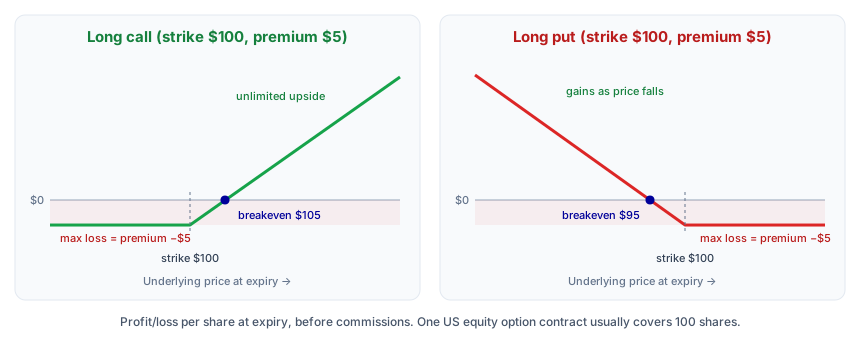
Long call
- Maximum loss: the premium paid
- Breakeven: strike + premium
- Maximum gain: theoretically unlimited
Long put
- Maximum loss: the premium paid
- Breakeven: strike − premium
- Maximum gain: strike − premium (if the underlying falls to zero)
Worked example
(Illustrative.) A stock is at $100. You buy one $100-strike call expiring in 30 days for $5.00.
- Cost: $5.00 × 100 shares = $500 — your maximum loss
- Breakeven at expiry: $100 + $5 = $105
| Stock at expiry | Option value | Profit / loss |
|---|---|---|
| $95 | $0 | −$500 |
| $100 | $0 | −$500 |
| $105 | $5 | $0 |
| $115 | $15 | +$1,000 |
Note: the stock must rise more than 5% just for you to break even. Being right about direction isn't enough — you must be right about how far and how fast.
5. Selling (writing) options
The seller of an option receives the premium and takes the opposite side:
- Short call: keeps the premium if the price stays below the strike — but faces potentially unlimited losses if the price rises sharply (unless they own the shares — see Covered calls, spreads, and straddles).
- Short put: keeps the premium if the price stays above the strike — but must buy the shares at the strike if it falls.
Selling options wins often (time decay works in the seller's favour) but can suffer rare, very large losses — the same tail-risk profile as mean-reversion strategies (see Trend-following vs mean-reversion vs breakout systems).
Common beginner mistakes
- Buying cheap, far out-of-the-money options and watching them expire worthless.
- Forgetting the 100-share multiplier when calculating cost and risk.
- Being right on direction but wrong on timing — time decay erodes the premium.
- Selling naked options for "income" without understanding tail risk.
- Ignoring liquidity — wide bid-ask spreads on options can be a large share of the premium.
Key terms
| Term | Meaning |
|---|---|
| Call / put | Right to buy / sell at the strike |
| Strike | The fixed contract price |
| Premium | The price of the option |
| Intrinsic value | Value if exercised now |
| Time (extrinsic) value | Premium above intrinsic value |
| ITM / ATM / OTM | In / at / out of the money |
| Breakeven | Price at expiry where the position neither gains nor loses |
| Writing | Selling an option and taking on the obligation |
Practice
- Open an option chain for a liquid stock or ETF. Find an ATM call and an OTM call with the same expiry. Split each premium into intrinsic and time value.
- Calculate breakeven and maximum loss for buying one contract of each.
- Note the bid-ask spread on each as a percentage of the premium.
- Write, in one sentence, what move — size and timing — you'd need for each to be profitable.
Quick recap
- A call is the right to buy; a put is the right to sell, at the strike, until expiry.
- Premium = intrinsic value + time value; time value decays to zero at expiry.
- Long options: maximum loss = premium; breakeven = strike ± premium.
- You need the right direction, size, and timing to profit.
- Selling options earns premium but carries large, rare losses — start with defined risk.
Educational content only — not financial advice. Trading involves substantial risk of loss. Practise on a demo account before risking real money.
Track your progress
Mark lessons complete, see your Essentials progress, and move up the 7-tier path.
Continue in Trading School