Tier 2 · Essentials · Indices & Futures · Module IX.2
Contango, backwardation, and index CFDs
Why futures trade above or below the cash index (fair value and cost of carry), what contango and backwardation mean, and how cash and futures-based index CFDs handle financing, dividends, and expiry.
Lesson 2 of 2 · 5 min read
Look at the S&P 500 on two platforms and you'll often see two different prices — one tracking the "cash" index, one tracking a futures contract. Neither is wrong. The difference comes from interest rates, dividends, and time. Understanding this cost of carry explains contango and backwardation, why rolling costs money, and exactly what you're paying for when you hold an index CFD overnight.
What you'll learn
- Fair value: why futures prices differ from the cash index
- Contango and backwardation, and what each shape of the futures curve signals
- The cost of rolling in each market
- How cash-based and futures-based index CFDs work
- Financing, dividend adjustments, and expiry on index CFDs
1. Fair value and the cost of carry
Buying the index through a futures contract instead of buying the shares means:
- You don't pay for the shares today, so you keep your cash earning interest → futures should be priced higher
- You don't receive the dividends the shares pay until expiry → futures should be priced lower
So, roughly:
Futures fair value ≈ cash index × (1 + interest rate − dividend yield), scaled for the time to expiry
Worked example
(Illustrative.) Cash S&P 500 = 5,000. Interest rate 4.5% a year, dividend yield 1.5% a year, three months to expiry.
- Net carry = (4.5% − 1.5%) × 3/12 = 0.75%
- Fair value ≈ 5,000 × 1.0075 = 5,037.5
A futures price about 37 points above cash is normal here — not a sign that the market expects prices to rise. The gap (the basis) shrinks towards zero as expiry approaches.
2. Contango and backwardation
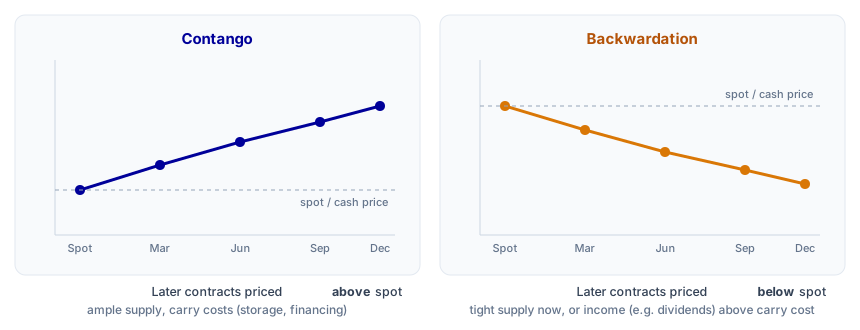
| Curve shape | Meaning | Index futures | Commodities |
|---|---|---|---|
| Contango | Later contracts priced above spot | Typical when interest rates exceed dividend yields | Ample supply; storage and financing costs |
| Backwardation | Later contracts priced below spot | When dividend yields exceed interest rates | Tight current supply (see Supply shocks, inventories, and geopolitics) |
For index futures, the curve shape mostly reflects rates vs dividends — it's mechanical, not a forecast. For commodities, it also reflects physical supply and demand.
3. What rolling costs you
When you roll a long position:
- In contango, you sell the cheaper expiring contract and buy the more expensive next one. Holding long exposure over many rolls tends to cost you the carry.
- In backwardation, the reverse — long positions can benefit.
This isn't a hidden fee; it's the price of the time value of money and dividends. But it matters for longer holding periods, and it's why a futures-based position can drift away from the cash index over months.
4. Index CFDs: two kinds
Brokers usually offer index CFDs in one or both of these forms:
| Cash (rolling / "spot") index CFD | Futures-based (forward) index CFD | |
|---|---|---|
| Priced from | The cash index level (often derived from the front futures contract, adjusted to fair value) | A specific futures contract |
| Expiry | None — can be held indefinitely | Expires with the underlying future |
| Overnight cost | Daily financing charge (or credit) | Built into the price; no daily financing |
| Spread | Usually tighter | Usually wider |
| Dividends | Dividend adjustments credited to longs / debited from shorts (for price-return indices) | Already reflected in the futures price |
| Best suited to | Short-term and intraday trades | Longer holds, where daily financing would add up |
Worked example: holding a cash index CFD
(Illustrative.) You hold a long cash S&P 500 CFD position with a notional value of $25,000 for 10 nights. The broker's financing rate is a benchmark rate plus a markup — say 7% a year in total.
- Financing ≈ $25,000 × 7% × 10/365 ≈ $48
- If an index constituent's dividend falls in that period, a small dividend credit partly offsets it.
For a two-day trade, financing is trivial. For a three-month swing trade, it can be meaningful — which is when a futures-based CFD or actual futures may make more sense.
Common beginner mistakes
- Reading the futures premium as a forecast that prices will rise.
- Comparing prices across platforms without knowing which is cash and which is futures-based.
- Holding cash CFDs for months without adding up the financing cost.
- Ignoring dividend adjustments on short index positions.
- Forgetting that futures-based CFDs expire.
Key terms
| Term | Meaning |
|---|---|
| Fair value | The theoretical futures price given interest rates, dividends, and time |
| Cost of carry | Net cost (or benefit) of holding an asset over time |
| Basis | The difference between the futures price and the cash price |
| Contango | Later-dated futures priced above spot |
| Backwardation | Later-dated futures priced below spot |
| Cash index CFD | A CFD tracking the cash index, with daily financing and no expiry |
| Futures-based CFD | A CFD tracking a specific futures contract, with expiry and no daily financing |
Practice
- Compare the S&P 500 cash index with the front-month future right now. What's the basis?
- Estimate fair value using current interest rates and dividend yield. How close is it?
- Look up your broker's financing rate and dividend-adjustment policy for its S&P 500 CFD.
- Calculate the financing cost of holding a typical position for 30 nights.
Quick recap
- Futures differ from cash by the cost of carry — interest minus dividends over time.
- For indices, contango usually just means rates exceed dividend yields; it isn't a forecast.
- Rolling in contango costs long holders the carry; backwardation can benefit them.
- Cash index CFDs have daily financing and dividend adjustments; futures-based CFDs expire and build carry into the price.
- Choose the instrument to suit your holding period.
You've completed the Indices & Futures track lessons. Take each module's knowledge check, then the Indices & Futures track exam to earn your Essentials badge.
Educational content only — not financial advice. Trading involves substantial risk of loss. Practise on a demo account before risking real money.
Track your progress
Mark lessons complete, see your Essentials progress, and move up the 7-tier path.
Continue in Trading School