Tier 2 · Essentials · Forex · Module FX.3
Trading NFP, CPI, and rate decisions
What happens to price and spreads around the biggest releases, and three professional ways to trade — or avoid — high-impact news.
Lesson 2 of 2 · 8 min read
The biggest scheduled events — the US jobs report, CPI, and central-bank decisions — can move a major pair more in five minutes than it moves in a typical quiet session. That creates opportunity, and it destroys accounts. The difference between the two is almost never about predicting the number. It's about understanding how the market behaves around the release, and choosing an approach that respects that behaviour.
What you'll learn
- The typical pattern of price and spreads before, during, and after a major release
- Why "straddling" the release with pending orders often disappoints
- Three professional approaches: stand aside, trade the aftermath, or hold a planned position
- How rate decisions differ from data releases
- A news-trading checklist
1. The anatomy of a release
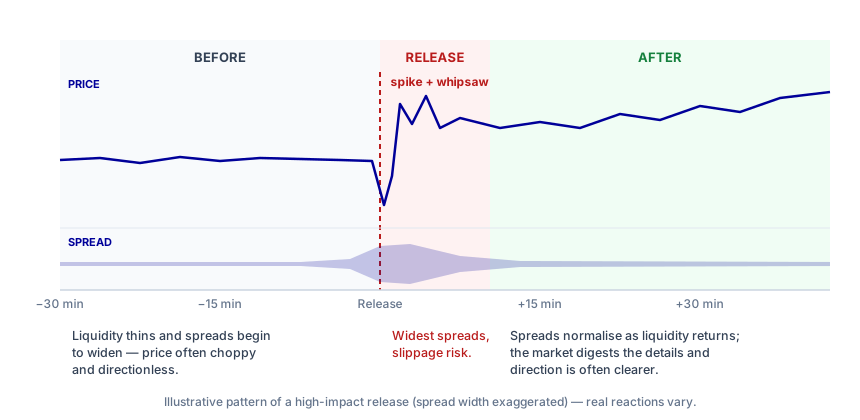
Before (roughly the last 15–30 minutes)
- Liquidity providers pull back and reduce size.
- Spreads start to widen; price is often choppy and directionless.
At the release (seconds to minutes)
- Price can jump tens of pips in an instant — sometimes in both directions (a whipsaw) as algorithms react to the headline, then to the details.
- Spreads are typically at their widest; stop orders can fill well beyond their level.
After (the following 15–60 minutes)
- Spreads return to normal as liquidity comes back.
- The market digests the full release — core, revisions, components — and direction is often clearer.
- Sometimes the first move continues; sometimes it fully reverses.
(This is a typical pattern — each release is different, and very large surprises can move price for hours or days.)
2. Why straddling the release often disappoints
A popular idea is to place a buy stop above and a sell stop below the price just before the release, so that whichever way price breaks, you're in.
In practice:
- Spread widening can trigger one or both orders before any real move.
- Slippage means your fill can be far from your order price.
- A whipsaw can trigger the buy, stop it out, then trigger the sell and stop that out too — two losses on one release.
3. Three professional approaches
Approach 1 — Stand aside
Close or avoid new short-term positions around high-impact releases for your currencies.
This isn't timid — it's what many professional discretionary traders do. It removes the most random, highest-cost minutes of the day from your results. Your pre-trade checklist already enforces it: no new trades within 30 minutes before a high-impact release.
Best for: beginners, short-term traders, anyone whose strategy isn't built for news.
Approach 2 — Trade the aftermath
Let the release happen, wait for spreads and price to settle, then trade the move that develops — using your normal setups.
A simple framework:
- Wait at least 15 minutes after the release (longer for central-bank press conferences).
- Read the release: actual vs consensus, revisions, and details. Is the picture clear or mixed?
- Check the chart: has price broken an important level and held it on a closing basis?
- Enter on a pullback or retest with your normal stop logic — never chase the spike.
Worked example
(Illustrative.) US CPI is released at 8:30 a.m. New York time. Core CPI is 0.2% m/m against a 0.3% consensus — softer than expected, and the details (services inflation) agree.
- EUR/USD jumps from 1.0850 to 1.0895 in two minutes, pulls back to 1.0872, then pushes to 1.0890 again.
- At 8:50 spreads are back to normal. Price is holding above a prior resistance zone at 1.0865–1.0870.
- At 9:05 a 15-minute candle retests 1.0870 and closes back above it.
- Entry: 1.0875. Stop: 1.0855, below the retested zone and the post-release low. Target: 1.0915, the next resistance → 20 pips risk, 40 pips reward (2 : 1).
The trader didn't predict CPI. They waited for the market to show how it interpreted the data, then used a normal setup with a normal stop and normal spreads.
Best for: intraday traders who want to take part in news-driven moves without the chaos of the first seconds.
Approach 3 — Hold a planned position through the release
If you're in a swing trade based on a longer-term view, you may choose to hold through the event — deliberately.
Rules for doing this professionally:
- The stop is wide enough to survive normal event volatility — and the position is sized so that a stop plus possible slippage is still acceptable.
- You're holding because the event is part of your thesis or irrelevant to it — not because you're hoping.
- You've decided in advance (see Reading the economic calendar) and you don't change the plan during the release.
Best for: swing and position traders whose timeframes make a single release less significant.
4. Rate decisions are different
Central-bank decisions usually come in two or more stages:
- The decision and statement — for example, the Fed's statement at 2:00 p.m. New York time.
- The press conference — for the Fed, usually 30 minutes later; for the ECB, shortly after its decision.
- Sometimes economic projections (such as the Fed's "dot plot" at some meetings).
The first reaction is to the decision and statement; a second, often larger move can come during the press conference as the chair answers questions about the future path of rates. That's why "trade the aftermath" means waiting until the press conference is well under way or finished.
5. Your news-trading checklist
Before trading any major release, answer every question with a clear yes or no:
- Do I know exactly when the release is, in my time zone?
- Do I know the consensus and what counts as a surprise in each direction?
- Have I decided my approach: stand aside, trade the aftermath, or hold a planned position?
- If I'm holding, is my position sized for stop + possible slippage?
- If I'm trading the aftermath, will I wait until spreads have normalised?
- Will I enter only on a normal setup — not by chasing the spike?
Any "no" means no news trade.
Common beginner mistakes
- Trading the first seconds after a release, when spreads and slippage are at their worst.
- Straddling the release with pending orders and getting whipsawed on both sides.
- Trying to predict the number instead of waiting to see how the market interprets it.
- Holding tight stops through a major release and being stopped out by the spread.
- Ignoring the press conference after a rate decision and getting caught by the second move.
Key terms
| Term | Meaning |
|---|---|
| High-impact release | A scheduled event that often causes large, fast moves |
| Whipsaw | A sharp move in one direction quickly followed by a sharp move in the other |
| Straddle (news) | Pending buy and sell stop orders placed on both sides of price before a release |
| Aftermath trading | Waiting for the release to settle and then trading the developing move |
| Press conference | The central-bank chair's post-decision briefing, often a second source of volatility |
| Dot plot | The Fed's chart of policymakers' rate projections, published at some meetings |
Practice
- Pick the next US CPI or NFP release. Don't trade it. Instead, record the spread on EUR/USD at −15 minutes, at the release, and at +15 minutes.
- After the release, mark on an M5 chart: the pre-release range, the first spike, any whipsaw, and where price was 30 and 60 minutes later.
- Identify whether an "aftermath" setup (retest of a broken level with normal spreads) appeared — and what its reward-to-risk would have been.
- Write your personal news rule — which approach you'll use, for which events — and add it to your trading plan.
Quick recap
- Around major releases, liquidity thins, spreads widen, and price can spike and whipsaw.
- Straddling releases with pending orders is often undermined by spreads, slippage, and whipsaws.
- Choose an approach in advance: stand aside, trade the aftermath, or hold a planned position.
- Rate decisions have multiple stages — the press conference can bring the bigger move.
- Use a yes/no news checklist; any "no" means no news trade.
You've completed the Forex track lessons. Take each module's knowledge check, then the Forex track exam to earn your Essentials badge.
Educational content only — not financial advice. Trading involves substantial risk of loss. Practise on a demo account before risking real money.
Track your progress
Mark lessons complete, see your Essentials progress, and move up the 7-tier path.
Continue in Trading School