Tier 2 · Essentials · Commodities · Module CM.2
Gold, the US dollar, and real yields
Why gold behaves like a macro asset — its relationship with real yields and the US dollar, the role of central-bank buying, and when the textbook breaks down.
Lesson 1 of 2 · 6 min read
Gold doesn't pay interest, earn profits, or get consumed like oil. So what actually moves it? For most of the modern era, the answer has centred on two macro forces: real interest rates and the US dollar — with fear and central-bank demand layered on top. Understanding these forces won't tell you what gold will do next week, but it will tell you what questions to ask, and help you recognise when the market's usual rules have changed.
What you'll learn
- Why gold is treated as a macro asset rather than an industrial commodity
- What real yields are and why they matter so much for gold
- How the US dollar affects gold prices
- The role of central-bank buying and physical demand
- Why these relationships sometimes break down — and how to adapt
1. Gold as a macro asset
Gold's demand comes from several sources:
| Source | What drives it |
|---|---|
| Investment (bars, coins, gold ETFs) | Interest rates, inflation fears, market stress, portfolio diversification |
| Central banks | Reserve diversification and reducing reliance on any single currency |
| Jewellery | Incomes and cultural demand — often price-sensitive |
| Technology | Electronics and industrial uses — a relatively small share |
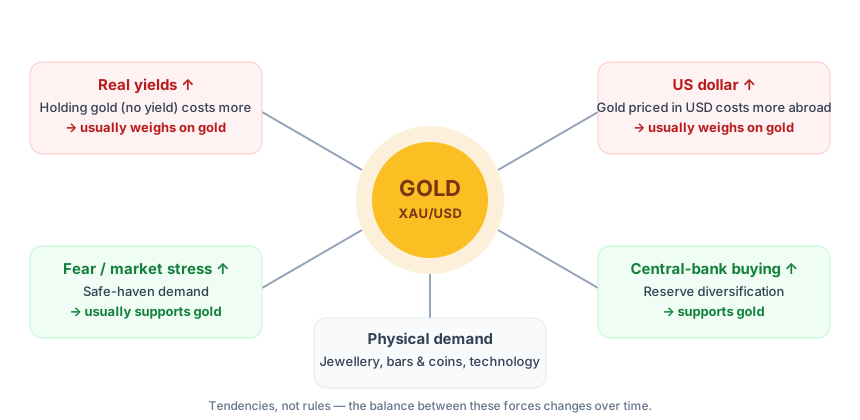
Because investment and central-bank demand dominate the changes in demand, gold responds mainly to financial and macro conditions. That's why XAU/USD often reacts to US inflation data or a Fed press conference more than to anything happening in a gold mine.
2. Real yields: gold's opportunity cost
Gold pays no interest. Holding it means giving up the return you could have earned elsewhere — that's its opportunity cost.
What matters isn't the nominal interest rate but the real rate — the return after inflation:
Real yield ≈ nominal yield − expected inflation
| Nominal 10-year yield | Expected inflation | Real yield | Gold's opportunity cost |
|---|---|---|---|
| 4.5% | 2.5% | +2.0% | High — bonds pay well above inflation |
| 3.0% | 2.5% | +0.5% | Moderate |
| 2.0% | 3.0% | −1.0% | Low — bonds lose to inflation, so gold's lack of yield matters less |
(Illustrative figures.)
Traders often use the yield on US inflation-protected Treasury bonds (TIPS) — for example the 10-year TIPS yield — as a market measure of real yields.
The typical relationship: when real yields rise, gold tends to come under pressure; when real yields fall, gold tends to benefit.
Connecting to the Fed
This is where the Forex track pays off. Data and central-bank decisions change expectations for interest rates (see Interest rates and central banks):
- A hawkish surprise from the Fed → higher expected yields → often bearish for gold.
- A dovish surprise or weak US data → lower expected yields → often bullish for gold.
3. The US dollar
Gold is priced in US dollars (XAU/USD). When the dollar strengthens:
- Gold becomes more expensive for buyers using other currencies, which can reduce demand.
- The same ounce of gold is "worth" fewer dollars in relative terms.
So a stronger dollar tends to weigh on gold, and a weaker dollar tends to support it. Because real yields and the dollar often move together (both tend to rise on hawkish Fed expectations), the two forces frequently reinforce each other.
Worked example
(Illustrative.) US CPI comes in hotter than expected.
- Markets price a more hawkish Fed → US Treasury yields rise.
- The dollar strengthens — EUR/USD falls, USD/JPY rises.
- Gold faces two headwinds at once: higher real yields and a stronger dollar.
- XAU/USD drops sharply in the minutes after the release.
Now the opposite: CPI comes in softer than expected → yields fall, the dollar weakens → gold often rallies.
4. When the textbook breaks
These relationships are tendencies, not laws. There are periods when gold has risen even as real yields rose and the dollar was strong. A notable example: from 2022 onward, central banks bought gold at a very high pace — more than 1,000 tonnes a year in 2022, 2023, and 2024, according to the World Gold Council — helping support prices despite higher real yields.
Other reasons the usual relationships can weaken:
- Geopolitical stress creating safe-haven demand that overwhelms rate effects
- Strong physical demand from large consumer markets
- Concerns about fiscal policy, debt, or currency debasement, which can support gold alongside a firm dollar
5. A practical framework for gold
Before trading XAU/USD, run through four questions:
- Real yields: are they rising, falling, or flat — and what data or Fed events this week could change that?
- US dollar: is it trending? What's the Fed-versus-others story?
- Risk sentiment: is there market stress or geopolitical tension that could drive safe-haven demand?
- Structural demand: is central-bank or physical buying being reported as unusually strong or weak?
If the answers point the same way, the macro backdrop is clear. If they conflict, expect choppier price action — and consider smaller size or waiting for technical confirmation.
Common beginner mistakes
- Treating gold like an industrial commodity and ignoring interest rates.
- Watching nominal rates instead of real rates.
- Assuming the gold–dollar relationship always holds, even when it clearly isn't.
- Trading gold through US data releases without asking what the data means for yields.
- Ignoring central-bank demand, which has been a major force in recent years.
Key terms
| Term | Meaning |
|---|---|
| Opportunity cost | The return given up by holding an asset that pays no income |
| Nominal yield | The stated interest rate on a bond |
| Real yield | Yield after inflation — roughly nominal yield minus expected inflation |
| TIPS | US Treasury Inflation-Protected Securities; their yields are used as a real-yield gauge |
| Dollar index (DXY) | A measure of the US dollar against a basket of major currencies |
| Reserve diversification | Central banks spreading their reserves across assets, including gold |
Practice
- Chart XAU/USD against the US 10-year TIPS yield (or real yield) over the last six months. Did they move in opposite directions?
- Compare XAU/USD with the US dollar index over the same period.
- Pick the most recent US CPI release. Record the move in the 2-year Treasury yield, EUR/USD, and XAU/USD in the hour after the release.
- Answer the four framework questions for gold this week, and write your macro bias in your journal.
Quick recap
- Gold behaves mainly as a macro asset, driven by investment and central-bank demand.
- Real yields are gold's opportunity cost — rising real yields tend to weigh on it.
- A stronger US dollar tends to weigh on gold, and often moves together with yields.
- Central-bank buying and geopolitics can override the usual relationships.
- Check whether correlations are holding now before relying on them.
Educational content only — not financial advice. Trading involves substantial risk of loss. Practise on a demo account before risking real money.
Track your progress
Mark lessons complete, see your Essentials progress, and move up the 7-tier path.
Continue in Trading School